

Edited by
Abhishek Kumar, Chandigarh University - Mohali, India.
Priya Batta, Amity University Punjab - Mohali, India.
J.P. Ananth, Dayananda Sagar University, Bengaluru, India.
ISBN : 9781836691532
Publication Date : November 2026
Hardcover 420 pp
170 USD
Co-publisher


Artificial Intelligence (AI) is rapidly transforming healthcare by enabling more accurate diagnoses, personalized treatments and efficient clinical decision-making. This book explores the growing role of intelligent technologies in advancing eye care and vision science.
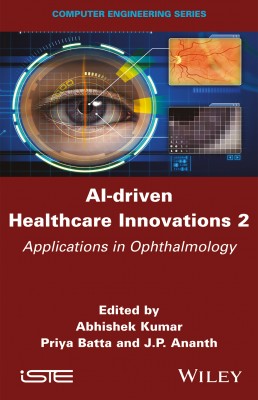
AI-Driven Healthcare Innovations 2 presents a comprehensive overview of AI-driven methodologies and their applications across ophthalmology, including disease detection, medical image analysis, predictive analytics, clinical decision support systems and teleophthalmology. It examines the integration of machine learning, deep learning, computer vision and data-driven healthcare frameworks for the diagnosis and management of ocular disorders such as diabetic retinopathy, glaucoma, age-related macular degeneration and retinal diseases. The book also highlights recent research developments, practical implementations and emerging trends that are reshaping ophthalmic practice.
Designed for researchers, healthcare professionals, academicians and students, this book serves as a valuable resource for understanding how AI technologies are enhancing the accuracy, accessibility and efficiency of modern ophthalmic healthcare.
1. ML-driven Early Detection of Retinal Diseases in Primary Care Settings, V.H. Karambelkar and Patil Ashish N.
2. Explainable AI in Ophthalmology: Building Trust in Automated Diagnosis, B.S. Joshi and Jujar Komal M.
3. Federated Learning Approaches for Privacy-Preserving Ophthalmic AI Models, Girish Arun Gadre and Pawar Atul Namdev.
4. AI-Powered Screening for Diabetic Retinopathy in Underserved Populations, Anjali Patil and Kadam Shrikant Rangrao.
5. Deep Learning for Multimodal Integration in Retinal Disease Classification, Gaurav Paranjpe and Inamdar Sharifnawaj Y.
6. Optimizing Ophthalmic Surgery Outcomes Using Predictive ML Algorithms, D.B. Shirke and Patil Zunjar V.
7. The Role of Reinforcement Learning in Adaptive Vision Therapy, Sanvedya Kadam and Shinde Patil Girisha Suresh.
8. Augmenting Human Expertise: AI Decision Support Systems in Ophthalmology Clinics, Prajakta Patil and Natu Milind A.
9. Transfer Learning Applications for Rare Ocular Disease Detection, Sonali Patil and Shinde Rutuja P.
10. Real-Time AI Assistance in Slit-Lamp Examination and Diagnosis, Renuka Sarwate and Deshmukh Manoj Janardhan.
11. Unsupervised Learning Techniques for Discovery of Novel Retinal Biomarkers, V.H. Karambelkar and Sonake Vanita V.
12. Developing Robust AI Models Against Bias in Ophthalmic Datasets, B.S. Joshi and Naikawadi Swapnil Sanjay.
13. Self-Supervised Learning for Retinal Image Feature Extraction in Low-Label Settings, Girish Arun Gadre and Patil Monika Virendra.
14. ML-Enhanced OCT Image Segmentation for Glaucoma Progression Monitoring, Anjali Patil and Patil Milin D.
15. Predictive Modeling of Myopia Progression in Children Using AI, Gaurav Paranjpe and Petkar Rajendra Vasantrao.
16. Combining Genomics and Imaging Data in Ophthalmology Using Multimodal AI, D.B. Shirke and Garagate Amruta K.
17. Benchmarking Ophthalmology AI Models: Challenges in Dataset Standardization, Sanvedya Kadam and Bardol Shabana M.
18. NLP for Clinical Note Analysis in Ophthalmic Practice, Prajakta Patil and Kadam Shweta A.
19. Using ML to Analyze Eye Movement Patterns in Neurological and Psychiatric Diagnosis, Sonali Patil and Kale Amruta B.
20. AI for Personalized Drug Response Prediction in Age-related Macular Degeneration, Renuka Sarwate and Patil Ashish N.
Abhishek Kumar is an Assistant Director and Professor in the Department of Computer Science and Engineering at Chandigarh University, Mohali, India. His research specializes in AI, renewable energy and image processing.
Priya Batta is an Associate Professor at Amity School of Engineering and Technology, Amity University Punjab, Mohali, India. Her research specializes in AI, blockchain and IoT.
J.P. Ananth is a Professor of CSE and Director–IQAC at Dayananda Sagar University, Bengaluru, India. He is a key contributor to academic quality assurance and examination systems.