


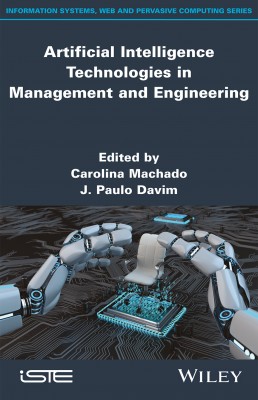
Edited by
Carolina Machado, University of Minho, Portugal.
J. Paulo Davim, University of Aveiro, Portugal.
ISBN : 9781836690528
Publication Date : May 2026
Hardcover 334 pp
170 USD
Co-publisher


Artificial intelligence (AI) technologies play a transformative role in several areas of knowledge, including management and engineering. Their adoption has been driven by the advancement of machine learning algorithms, increased computing power, and the availability of large volumes of data, making AI technologies indispensable for process optimization and strategic decision-making. However, organizations must invest in research, development and professional training to ensure AI is used ethically and sustainably to drive progress.
This book makes several contributions, by not only advancing scientific and technical knowledge, but also improving efficiency and decision-making, and developing new tools and technologies.
The main aim of Artificial Intelligence Technologies in Management and Engineering is to provide a channel for sharing and disseminating knowledge of new advances in AI technologies in management and engineering among academics/researchers, managers and engineers. It seeks to advance research in the field, provide practical insights for managers and engineers, and also serve as a basis for future technological innovations.
1. From Algorithms to Applications: AI in Management and Engineering, Hamed Taherdoost and Mitra Madanchian.
2. Generational Perspectives on AI (From Baby Boomers to Gen Z): Understanding, Perceived Usefulness, Motivation to Adopt and Risk Perception, Flor Morton, Teresa Treviño-Benavides, Daniel Javier De La Garza Montemayor and Ana Valdés Loyola.
3. Smart Decisions: How AI Is Transforming Everyday Management and Engineering Practices, Soha Rawas, Cerine Tafran, Agariadne Dwinggo Samala, Feri Ferdian and Yudha Aditya Fiandra.
4. Integrating AI into Business Education: Bridging the Gap Between Disciplinary Knowledge and Business Performance, Laura Esther Zapata Cantú and Martha Elena Moreno Barbosa.
5. Holistic Management Quo Vadis? Designing Management Dispositive and Metamorphic Possibilities in the Age of AI, Patrick Baretto and Qeis Kamran.
6. Mapping the Use of Generative AI in Spain’s Advertising Sector: Current Trends and Future Challenges, Juan Manuel Corbacho Valencia, Jesús Pérez Seoane and Xabier Martínez-Rolán.
7. Emotional Nudging in the Rise of Affective Artificial Intelligence, Cristiana Cerqueira Leal and Benilde Oliveira.
8. Agentic AI in Marketing: Opportunities, Challenges and Impact on Firm Performance, Florin Sabin Foltean and Octavian Dumitru Hera.
9. AI’s Role in Marketing: Mapping the Evolution of Creativity, Teresa Treviño-Benavides and Flor Morton.
10. Unveiling Management Research’s Thematic Evolution: An Unsupervised Machine Learning – Latent Dirichlet Allocation Perspective, Qeis Kamran.
11. The Use of AI in Human Resource Management: Barriers, Opportunities and Trends, Pedro Miguel Torres Barros and Carolina Machado.
Carolina Machado is an associate professor with habilitation at the University of Minho, Portugal. She has lectured on HRM subjects since 1989. She is currently the Head of the HRM Work Group at the University of Minho and is also the Editor-in-Chief of the International Journal of Applied Management Sciences and Engineering.
J. Paulo Davim is a professor at the University of Aveiro, Portugal and is also distinguished as an honorary professor in several universities/colleges/
institutes in China, India and Spain. He has more than 35 years of teaching and research experience in mechanical and industrial engineering.


